Uasin Gishu County, long identified with maize and wheat, is making a push to establish coffee as its next high-value crop, and South Korea may be the market that makes it work.
At a meeting with a South Korean delegation at the county headquarters on Monday, Governor Jonathan Bii Chelilim said the county is courting investors from Seoul in a proposed partnership that could open international markets to local farmers. The time had come, he said, for farmers to diversify away from grains and into crops with higher income potential.
"We want to change the culture of growing grains to coffee because this is a high-value crop that will change the fortunes of farmers in our county," Dr Bii said.
A market that already admires Kenyan coffee
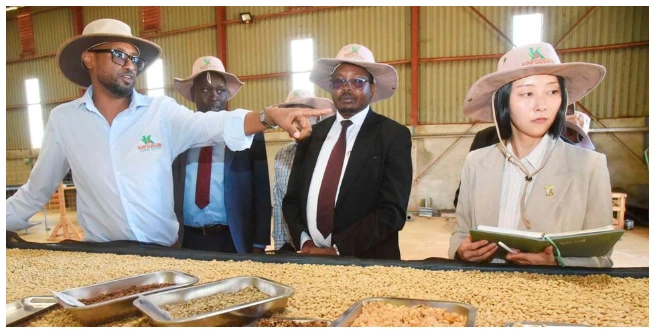
Sera Park, director of External Corporation for the South Korean delegation, said Kenyan coffee is highly regarded in her country, which holds coffee festivals and competitions every year. Kenyan entries, she said, have consistently performed well.
"Our country always hosts coffee festivals and coffee competitions every year and from the competitions, Kenyan coffee has always been emerging as the winner. This will give you (Uasin Gishu) a high chance of our markets buying coffee directly from here," Ms Park said.
The delegation said South Korea's strong coffee-drinking culture means its market is ready to receive Kenyan produce, and the Korean investors have expressed interest in sourcing directly from Uasin Gishu.
What the county has to offer
County Coffee Development Officer Nicholas Maritim said the region has suitable agro-ecological conditions, with altitudes ranging from 800 to 2,700 metres above sea level. Coffee could grow in all six sub-counties: Ainabkoi, Kapseret, Kesses, Moiben, Soy and Turbo, which would extend production well beyond the traditional grain-growing areas.
"We have conducted thorough research on our soils and everything is favourable for coffee production," Mr Maritim said.
The county currently has 1,686 hectares under coffee. It is promoting Arabica varieties including Batian, Ruiru 11, SL28, SL34 and K7, and has distributed more than 2.5 million seedlings over the past three years. Extension services have also been strengthened, with farmers trained in crop establishment and management, pest and disease control, and harvesting.
Room to grow on yields
The production figures show how much ground remains to be covered:
- Smallholder farmers: an average of 769kg per hectare
- Estate farmers: 3,964kg per hectare
- Potential yield: 6,428kg per hectare
The proposed Korean partnership is expected to give farmers an added incentive to invest by offering access to international buyers.
Infrastructure, and a missing link
Dr Bii said Uasin Gishu's transport network would support the movement of coffee to local and export markets, citing Eldoret International Airport, the railway line and the road network.
"We are the City of Champions and once we venture into coffee farming, we shall take over the sector and become number one in the country. Our county has good roads, an international airport for quick exportation and a railway line," he said.
The county does not yet have a coffee milling plant, a gap the governor said the administration is working to close. "Right now we don't have a milling plant but we are setting up one so that once completed, it will promote value addition and quality management, improve market access and farmers' bargaining power, and increase farmers' returns through better marketing opportunities," he said.
A shift across the grain basket
The county's move reflects a wider change in the North Rift, Kenya's traditional grain basket, where farmers are reducing acreage under maize and wheat in favour of tea, coffee and sugarcane. Rising production costs, erratic weather and unstable maize prices have made cereals a harder bet. In some areas, drought losses have left farmers reluctant to replant despite subsidies on fertiliser and certified seed.
Coffee's appeal is also being helped by price signals. President William Ruto has announced that the price of a kilogramme of coffee has doubled from Sh60 to Sh120 of Cherry.
In neighbouring Trans Nzoia County, farmers are also turning to coffee, encouraged by the revival of previously collapsed cooperative societies and better returns.
Established regions still dominate the national picture. Kericho led in deliveries by volume in the 2025/26 season, supplying 6,624 metric tonnes to the Nairobi Coffee Exchange, while Kirinyaga led in earnings with Sh7.48 billion.
The food security question
Uasin Gishu's ambitions raise a policy dilemma. Agricultural experts have warned that continued cuts in land under staple crops could weaken Kenya's ability to meet domestic grain demand, increasing reliance on imports and exposing consumers to shortages and higher prices.
The challenge for the county, then, is to improve farmers' earnings through diversification without undermining the region's role as a major food-producing zone. For now, Uasin Gishu is betting that reliable export markets, a local milling plant and better yields can make coffee a major part of that answer.